When I reflect on the times in my career that perfect alignment of environmental factors resulted in high productivity and innovation, the following themes come to mind:
1. A sense of urgency to change - John Kotter's change model starts with creating urgency. A perfect 2011 example of this is Meaningful Use Stage 1. All stakeholders recognize that MU is a high priority requiring complete organizational focus with a well understood timeframe and clear outcomes.
2. A clearly defined scope - Often, business owners choose software solutions before they analyze their workflows and define requirements. Automating a broken process does not make it better. The rational way to approach projects is define an ideal workflow, develop requirements, create specifications for automation, and build/buy products. Currently, BIDMC is designing the medication workflow of the future. Our first step was to assemble all the stakeholders for a 3 day retreat to define the ideal functional characteristics without being biased by existing technology or practices. In the next two years, you can expect us to create an automated medication workflow that looks more like a Toyota production system and less like a traditional hospital ward.
3. A guiding coalition of leaders serving as champions for the project and providing ideal leadership characteristics - leaders need to be positive, visionary and supportive, not angry, autocratic and arbitrary.
4. A dedicated implementation team and appropriate funding - How many times have you been asked to do more with less? Eventually you'll do everything with nothing. Your lean and mean teams will become bony and angry. If an urgent project with a tightly defined scope and unified leadership is resourced with dedicated staff, you'll be unstoppable.
5. A timeframe that makes it possible to do the project with enough attention to detail that the result is high quality, well communicated, and innovative - every project needs to link time, scope and resources. 9 women cannot have a baby in 1 month. A fixed scope and fixed resources implies a fixed time. Attempts to artificially shorten the time will compromise scope or quality. A project that goes live at the right time, even if the timeframe seems long, will never be remembered. A project that goes live too early will never be forgotten.
May you all have the time, resources, scope, noble leaders, and urgency you need to succeed. May you be driven by innovation and the desire to make a difference instead of a pugilistic project manager creating fear of failure. May you all have your Man on the Moon moment.
These are the successes we'll tell our grandchildren about.
Wednesday, 13 July 2011

Tuesday, 12 July 2011
The Demand for a Free Service is Infinite
As CIOs we have significant responsibility but limited authority. We're accountable for stability, reliability, and security but cannot always control all the variables.
Here's an example of random events coming together to create a problem, which is now well on its way to resolution. However, there are many lessons learned that I'd like to share with you.
Timeline
November 2010 - Harvard Medical School financial and compliance experts asked for a temporary hold on computing and storage chargebacks, ensuring a thoughtful service center model could be implemented which adheres to every rule and regulation for grant funds flow.
January-March 2011 - Many ARRA grants enabled the research community to purchase microscopes, next generation sequencers, flow cytometry equipment, and other tools/technology that generate vast amounts of data. There was no specific process in place that required storage/IT resource plans before the purchases were made.
April 2011 - The Research Information Technology Group expanded the number of CPU Cores in our high performance computing cluster from 1000 to 4000. Although this did not specifically create an additional storage burden, it enabled the community to run 4 times as many jobs, increasing I/O demand.
May 2011 - All the new research equipment and tools/technologies were turned on by the research community. Storage demands grew from 650 terabytes to 1.1 petabytes in a few weeks. In parallel, next generation sequencing software, which tends to do millions of reads/writes, ran 4 times more often. At the same time. all IT resources were available without a chargeback. Effectively, the demand for a free service became infinite.
June 2011 - A few hours of storage downtime occurred as capacity crossed a threshold such that fewer hard drives were available to handle the I/O load. We initiated a series of immediate actions to resolve the problem, as described in my email to the community below
"Dear HMS IT User Community:
As a followup to my June 14 email about our plan to rapidly improve storage performance and capacity, here is an update.
The demand for storage between April and June 2011 increased 70%, from 650 Terabytes to 1.1 Petabytes (1,100,000,000,000,000 bytes), and research storage activity doubled. Per our promise we have
1. Separated all web and other applications into their own storage cluster, enhancing the speed and reliability of all our applications
2. Separated all home folders and administrative collaborations into their own storage cluster, enhancing the speed and reliability of file access for every user
3. Planned migrations of several research collaborations into a separate pool of specialized high speed storage.
4. Retained an expert consultant to provide an independent review of our storage infrastructure in 3 phases - short term improvements to ensure stability, medium term improvements to support growth, and long term improvements to ensure sustainability. Their report will be presented to the Research Computing Governance Committee tomorrow. After all stakeholders have reviewed that report, we will use existing budgets to make additional storage purchases that are consistent with the long term needs of the community.
5. The Research Computing Governance Committee is also working hard on policies to ensure everyone is a good steward of IT resources. A collaboratively developed chargeback model for computing and storage is nearly complete and will be widely vetted for feedback. Until the chargeback model is in place, we'll continue to use quotas to limit growth. By enhancing our storage supply and managing our demand, we will all be successful.
In the meantime, faculty will be receiving a note from the chair of the Research Computing Governance Committee, with further information and suggestions regarding efficient use of computing resources.
Thanks for your ongoing support, we're making progress
John"
What can we learn from this?
1. Policy and Technology need to be developed together. No amount of hardware technology will satisfy customer needs unless there is some policy as to how the technology is used. I should have focused on demand management in parallel with supply management, enforcing rigorous quotas and providing useful self-service reports while the chargeback model was being revised.
2. Governance is essential to IT success. Although no one in the user community relayed any storage plans or issues to me, there should have been appropriate committees or workgroups established to coordinate efforts among research labs. In administrative and educational areas, it's common for groups to coordinate efforts with enterprise initiatives. In research areas, it's more common for local efforts to occur without broad coordination. Establishing governance that includes all research lab administrators would help improve this.
3. Approval processes for purchases need to include IT planning. When grants are used to purchase equipment there is no specific oversight of the infrastructure implications of adding such equipment on firewalls, networks, servers and storage. Purchases that generate data should require additional approvals to align infrastructure supply and demand.
4. Be wary of "Big Bang" go lives. Our high performance computing upgrade was a single event - 1000 cores to 4000 cores. This should have been phased to better assess the impact of the expansion on application use, other elements of infrastructure, and customer expectation.
5. Know your own blind spots. As with the CareGroup Network Outage, there are aspects of emerging technology which are so new that I do not know what I do not know. When storage demand increases by 70% and throughput accelerates by a factor of 4, what happens to an advanced storage infrastructure? Bringing in a third party storage consultant would have filled in knowledge gaps.
In the world of healthcare quality, there's an analogy that error is like slices of swiss cheese. If a stack of individual slices is lined up precisely, you can get a hole all the way through the stack. In this case, a series of unrelated events lined up to create a problem. I hope that IT professionals can use this episode to realign their "slices" and prevent infinite demand from impacting a limited supply.
Monday, 11 July 2011
Can Blogging be Harmful to Your Career?
I blog 5 days a week. This is my 935th post. Monday through Wednesday are generally policy and technology topics. Thursday is something personal. Friday is an emerging technology.
Everything I write is personal, unfiltered, and transparent. Readers of my blog know where I am, what I'm doing, and what I'm thinking. They can share my highs and my lows, my triumphs and defeats.
Recently, I had my blog used against me for the first time.
In discussing a critical IT issue, someone questioned my focus and engagement because I had written a post about single malt scotch on June 2 at 3am, recounting an experience I had Memorial Day Weekend in Scotland.
I explained that I write these posts late at night, in a few minutes, while most people are sleeping. They are not a distraction but are a kind of therapy, enabling me to document the highlights of my day.
I realize that it is overly optimistic to believe that everyone I work with will embrace values like civility, equanimity, and a belief that the nice guy can finish first.
If Facebook can be used against college applicants to screen them for bad behavior and if review of web-based scholarly writing can be used by legislators to block executive appointment confirmations, what's the right way to use social media to minimize personal harm?
There are three possibilities
1. Ignore the naysayers - blog, tweet, chat, IM, and wiki as you wish!
2. Give up - the world is filled with angry people who can stalk you, harass you, and criticize you. Better to keep your thoughts private.
3. Write what you think, back it up with evidence, and temper your emotions - assume the world will read everything you write and have an opinion, but transparency and communication, as long as it is fair, is the best policy.
I've chosen #3.
Why did the person criticize me for blogging about Single Malt?
I have three ideas
1. Maybe they did not understand that I only blog for a few minutes at the end of my 20 hour day, when all work and family responsibilities are done to the extent I can do them. Hence my blogging does not detract from anything else I do.
2. Maybe they cannot accept that I've done everything I can to serve my customers in the 20 hour day before blogging. In that case, it falls under my leadership principle, "You cannot please everyone".
3. Maybe life is not fair and I should be judged by different criteria than other people. When I was 15, I wrote in my journal "If you are judged using rules that are inherently unfair or unreasonable, then you should realize that the game cannot be won. Stay true to your values, work hard, and all will be well." No matter what people say or how harshly they criticize me, even when their ideas are not factual, I will stay true to my values - not pursuing fame or fortune, but simply trying to make a difference.
So the answer to the question is yes, blogging can hurt your career. However, if you take the high road, you'll always get to where you want to be.
Friday, 8 July 2011
Cool Technology of the Week
When I was 10 years old in 1972, I mentioned to my father that some day the analog world we live in would be digitized and if the sampling rate were fine enough, we would not be able to distinguish an analog picture from a digital one. Thereafter, sights and sounds could not be trusted because all media could be easily manipulated by rearranging the data.
The manipulation of digital photo data, considered science fiction in 1972, is something every teenager can do on their smartphone today.
What's next?
How about photos with an infinitely variable focus that can manipulated after you take them? Lytro, a spin out from Stanford University, enables you to readjust the focus to any point in the picture after the fact. I recommend you test drive the technology on their website
Lytro has built a new kind of camera sensor which captures every ray of light hitting it. Lytro also has software to turn that data into the shifting-focus images.
With this new camera, you can take photos of major life events, hard to capture objects in motion, or even the Loch Ness monster and not worry about focusing - just do it later.
That's cool
Thursday, 7 July 2011
Experiencing the Alaskan Wilderness
When I wrote about hiking Denali, I did not know what to expect from the 49th State.
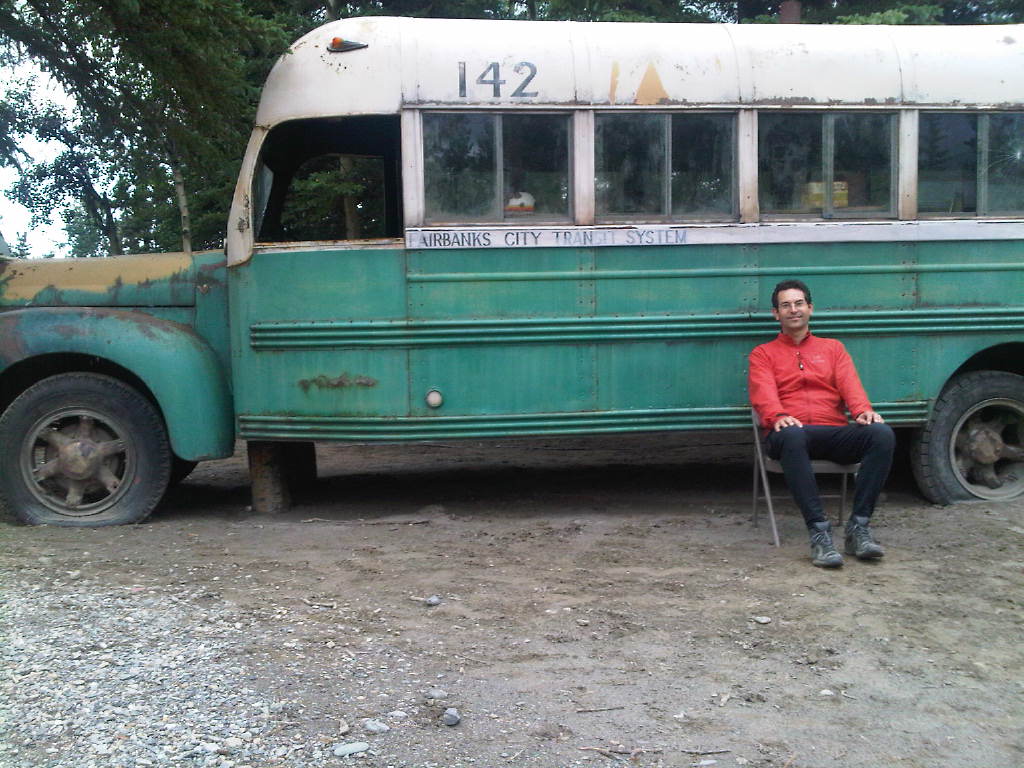
Having spent the last week in Alaska with my family and experienced the terrain, flora and fauna, I can now describe Alaska in all its grandeur.
We began our trip in Girdwood, 40 miles to the South of Anchorage. This area of Chugach National Forest is a temperate rain forest, which receives 120 inches of precipitation every year and is reminiscent of moss covered forests of Olympia National Park. I hiked the Winner Creek Trail to a hand trolley river crossing and then onto the Crow Creek trail a section of the traditional Iditarod route - about 10 miles for the circuit. A truly beautiful walk through lush and dense forest. Two great horned owl fledgelings serenaded me along the way.


We drove the Seward highway and explored the Exit Glacier via the Harding Icefield trail. Amazing deep blue ice and deep crevasses

We moved on to Anchorage so that I could meet with IT leaders and folks working on statewide EHR/HIE projects. After my lectures, Stewart Ferguson CIO, Alaska Native Tribal Health Consortium and I hiked 20 miles with 8000 feet of elevation gain through the Chugach State Park. We began at Glen Alps trailhead and hiked 6 miles to Ship Lake. From there we went off trail and climbed a 1000 foot ridge, then a 1000 foot glacier to reach Bird Ridge. We traversed the Bird Ridge Overlook and did a 3500 foot descent to Turnagain Arm. A truly amazing day - no need for a headlamp because in late June at 61 degrees North latitude, there is no darkness.

The next day, my family traveled to Talkeetna, the gateway to Denali National Park and the amazing peeks of Foraker, Hunter, and McKinley. We took the Talkeetna air taxi to Denali base camp and landed on the Pika Glacier. I met two climbers (medical students from the University of Washington) and we discussed the rock routes of Little Switzerland, moderate granite climbs of 5.8-5.9. So far this year, there have been 9 deaths on McKinley and the surrounding mountains. Foraker was particularly intimidating because of its cornices - rock edges covered with snow that looks like whipped cream - one step through a cornice is fatal.


An amazing trip. I look forward to returning and exploring the mountains/rivers of the Kenai Peninsula by driving along the Sterling Highway to Homer, Alaska.
I have long admired the work of Richard Proenneke (the book One Man's Wilderness and the PBS documentation Alone in the Wilderness) and hope to visit the Twin Lakes region of Lake Clark National Park, the least visited national park with 4 million acres and 5000 visitors per year.
Although I'm steeped in technology and sometimes described as an alpha geek there is something to be said for he homesteading lifestyle, defined as “a lifestyle of simple agrarian self-sufficiency". Alaska may the the ideal spot for my version of Thoreau's cabin in the woods.
Wednesday, 6 July 2011
Testimony to the HIT Policy Committee
Doug Fridsma and I were asked to brief the HIT Policy Committee about the current activities of the HIT Standards Committee, ensuring coordination as we all work to finalize Meaningful Use Stage 2.
We used this presentation, which covers three major themes:
*Meaningful Use Stage 2 gap analysis work
*The Standards Summer Camp Activities
*The Standards and Interoperability Framework activities
Doug started by reiterating the guiding principles of the HIT Standards Committee which essentially translate into
"We will select no standard before its time"
Doug reflected on the way we select standards, assigning each requirement to one of four "buckets"
a. Functional criteria only – no standards are needed
b. Sufficient standards and implementation guides are available
c. Existing standards are available but not implementation guides
d. No standards or implementation guides are available
He discussed early work to place proposed Meaningful Use Stage 2 policy goals into these 4 buckets.
Since many of the Stage 2 goals will not have supporting standards and implementation guides in time for the regulations, it's like that some of stage 2 will be described using functional criteria and not standards. What does that mean? Here's an example
Electronic medication administration records (EMAR) are unlikely to require a specific bar code format. Instead, it will be sufficient to require that a certified application be capable of 5 functions
*Generate alert for wrong patient
*Generate alert for wrong medication
*Record the dose and route
*Record the provider administering the medication
*Record the time/date the medication was administered
Implementation details will be left to the creativity of the marketplace.
I described the Standards Summer Camp schedule and offered updates on
• Metadata
• Patient Matching
• ePrescribing
• Surveillance Implementation Guide
• NwHIN
Doug completed the presentation by describing the Standards and Interoperability Framework Projects
*CDA consolidation
*Transitions of Care
*Lab Results reporting
*Provider directories
*Distributed query (Using a web browser to query multiple databases such as is done with Shrine/I2B2 )
We took questions from the committee including how best to develop drug/drug interaction standards, how the policy committee can best work with the standards committee by providing requirements early and often, and how we can all plan for the future of stage 3.
A great meeting!
Tuesday, 5 July 2011
Alaskan Healthcare IT Lessons Learned
Alaska faces many healthcare challenges given its large area (663,268 sq mi) and population of 710,231 residents (as per the 2010 US Census), approximately half of which live in the Anchorage metropolitan area, making Alaska the least densely populated state. Roads are limited, making boat and small plane the only means of transportation to many locations, especially in the western portion of the state.
The geographical challenge of delivering such widely distributed healthcare makes it a natural location for telemedicine, much of which is ably overseen by Stewart Ferguson CIO, Alaska Native Tribal Health Consortium.
The business case is simple - provider travel to remote villages and patient commuting to downtown clinics is expensive for providers and patients.
Because telemedicine has become part of the culture of Alaskan care delivery, healthcare information exchange is likely to be very successful. When a patient is referred to a specialist, lifetime medical summaries should be sent before the consultation. When the telemedicine encounter is done, a summary of the evaluation should be sent back to the primary care giver or health aide in the village.
Alaska has what I consider the perfect alignment of incentives needed for a successful HIE
a. Complete support of all payers and providers that HIE (coupled with Telemedicine) saves money by reducing travel
b. A universal expectation by providers and patients that HIE will occur following each encounter
c. A population of patients who understands the need for HIE and supports a simple consent model (opt-out)
d. Government support for HIE with strong public-private governance and delegation of HIE operations to a multi-stakeholder non-profit, the Alaska eHealth Network (AeHN) a 501c3 Alaska corporation organized and managed by Alaskans.
e. The stakeholders chose a single vendor, Orion, to provide the backbone which will connect all their EHRs.
A network of networks approach makes great sense for a state with regional centers of excellence and highly distributed broadband like Massachusetts. Alaska has some broadband but relies on satellite and microwave connections, which are limited in bandwidth and very expensive. Alaska does not distribute IT staff and infrastructure support to distant villages. Thus, for Alaska, a single network and a centralized clinical data repository supporting:
Composite Record Viewing
Master Patient Index / Record Locator Service
Audit Trails/Security
Patient Portal
Public Health Reporting
makes great sense.
The folks in Alaska working on HIE, led by Wiiliam Sorrells, are highly motivated, have done a great job with education/communication, and share a common vision.
I predict that Alaska will become one of the most successful HIEs because of its clear business case, alignment of incentives, and broad stakeholder engagement.
I look forward to working with my colleagues in Alaska as we all develop the Nationwide Health Information Network, connecting all the successful state HIEs together.
Subscribe to:
Posts (Atom)

